Publication
Field validation of Hydrotwin for automated vessel and dolphin detection
Joachim Vanneste; Tiago Gomes; Pedro Raposo; Astrid van Toor; Diogo Valdrez; Guilherme Beleza Vaz
During the NATO REPMUS 2025 exercise off the Portuguese coast, we deployed six Hydrotwin passive acoustic monitoring systems and put them through 17 days of real-world conditions — mixed military and civilian vessel traffic, open-ocean swell, and the resident bottlenose dolphin populations of the Sesimbra coast. The results confirmed what we built Hydrotwin to prove: passive acoustics can detect what AIS alone cannot.
The maritime intelligence gap that acoustics fills
Reliable detection of vessels and marine mammals has always required something from the target — a radio transponder, a visual sighting, a cooperative signal. The Automatic Identification System (AIS), while widely adopted, is fundamentally a broadcast technology: it only works when a vessel chooses to transmit. Fishing boats, small craft, and vessels operating with inactive transponders remain invisible to conventional maritime monitoring systems.
Hydrotwin was designed to close that gap. As a passive acoustic monitoring system, it listens continuously to the underwater sound environment without emitting any signal of its own and without requiring any cooperation from the vessel or animal being detected. Onboard CNN-based AI models process raw acoustic data directly on the device, classifying sources in real time — from dolphin whistles to naval vessel propeller harmonics — and transmitting detections to our cloud dashboard via cellular or satellite connectivity.
The NATO REPMUS (Robotic Experimentation and Prototyping with Maritime Unmanned Systems) 2025 exercise gave us the most demanding and realistic validation environment we could have asked for.
Three product configurations, one exercise
Hydrotwin operates in three hardware configurations, each sharing the same AI processing framework but optimised for different deployment contexts.

HT-Spotter (HT-S)
The HT-Spotter (HT-S) is designed for open-ocean deployments. Operating on the Spotter buoy platform for power and telemetry, it records 12 minutes in every 30 to balance continuous coverage with battery autonomy. During REPMUS, five HT-S units were deployed at varying depths — two at 10 metres and three at 65 metres — across the offshore area between Sesimbra and the Tróia peninsula.

HT-Cable (HT-C)
The HT-Cable (HT-C) is designed for coastal, cabled environments. Connected to shore power and data infrastructure, it records continuously — one-minute file after one-minute file — making it the right tool for long-term fixed monitoring. For the duration of the exercise, one HT-C unit was installed on an artificial island in Tróia Bay.

HT-Vessel (HT-V)
The HT-Vessel (HT-V) brings the same detection intelligence to autonomous surface vehicles. During the military exercise, a hydrophone with a 15-metre towed line was deployed from the Scout USV — a survey platform built by OnlineOceans — turning it into a mobile acoustic intelligence asset.
All three configurations run identical firmware on a shared computing unit. The AI architecture was designed for resource-constrained edge deployment — up to 90% less resource-intensive than comparable edge-optimised models such as YOLO Nano and EfficientNet — while retaining the ability to identify a wide range of underwater sources including dolphin whistles, whale calls, and multiple vessel classes.
A 17-day validation in live NATO conditions
REPMUS 2025 took place between September 8th and September 25th 2025, in the waters between Sesimbra and the Tróia peninsula. The exercise involved multiple vessel classes transiting across operational areas throughout its duration, providing a rich and realistic acoustic dataset. The coastal waters south of Sesimbra are also home to resident bottlenose dolphin populations, whose acoustic activity during the exercise gave us concurrent ground truth for cetacean detection validation.
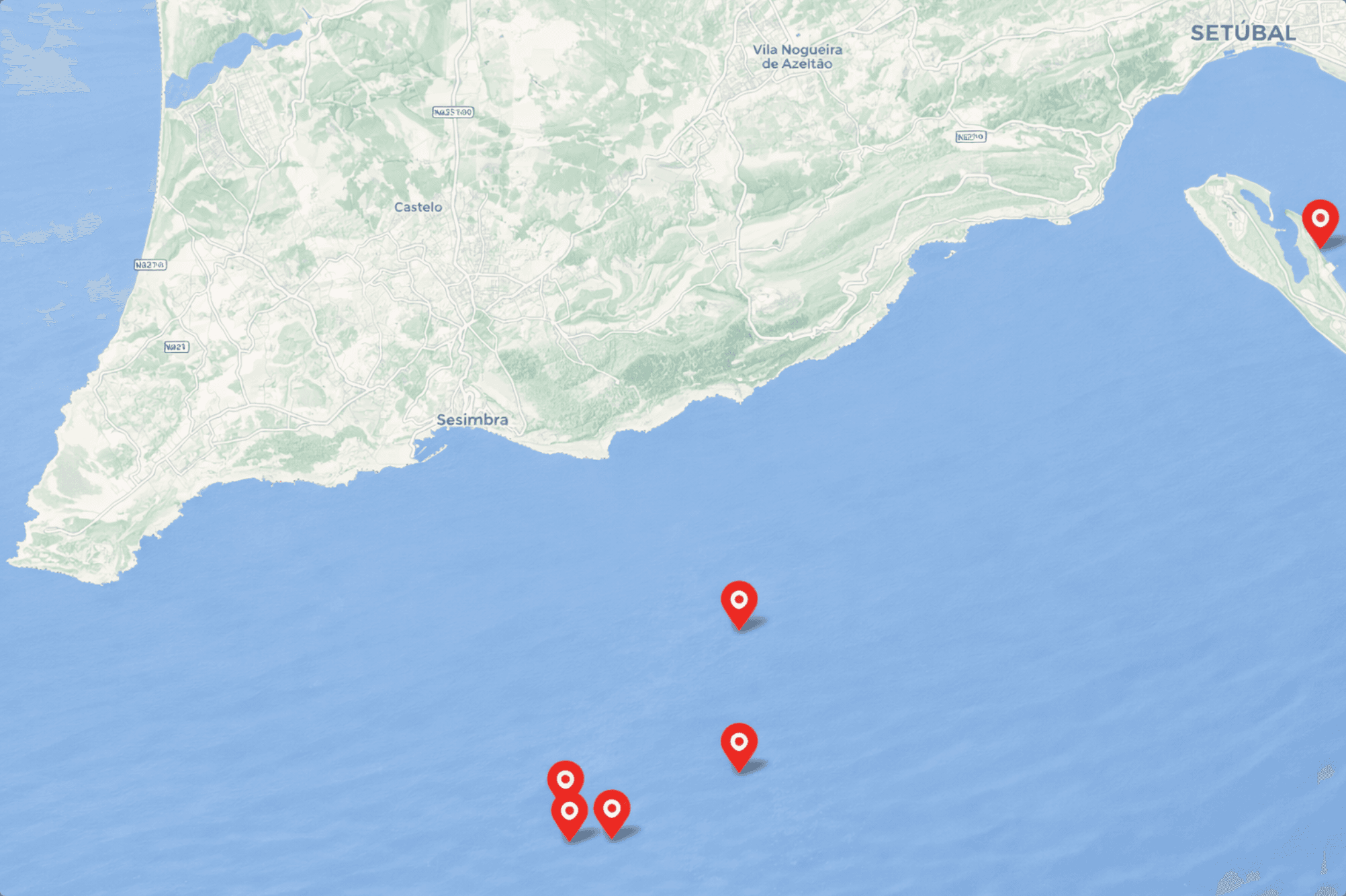
Deployment locations of six Hydrotwin units during REPMUS 2025. Five HT-S units were positioned offshore at varying depths; one HT-C unit was installed in the coastal waters of Tróia Bay.
Ground truth for vessel detection was derived from AIS data and STANAG 4817 — the NATO standard for vessel tracking. Before running performance metrics, we verified AIS coverage against expert-labelled acoustic events from three units over three days: 91.9% of the 236 labelled vessel events had corresponding AIS targets within 5 km, confirming AIS as a reliable ground truth within Hydrotwin's operational detection range. Dolphin detection was validated separately against expert-annotated whistle labels produced by our in-house acoustic team.
Across the full exercise, the five HT-S units recorded nearly 1,800 hours of acoustic data across 8,974 files. The HT-C unit, running continuously, generated a further 615 hours across 36,937 one-minute recordings.
Vessel detection: the depth effect
For the HT-S units, the results confirmed a clear and physically intuitive pattern: shallower deployments outperform deeper ones.
The two units deployed at 10 metres depth — HT-S-007 and HT-S-008 — achieved a mean F1-score of 89%, with precision above 88% and recall above 90%. The three units at 65 metres depth returned F1-scores between 59% and 63%. This depth dependence is consistent with acoustic propagation physics: shallower deployments experience less signal attenuation for surface vessel noise, giving the AI model a stronger, cleaner input.
To probe the system's effective detection range, we varied the spatial matching radius between Hydrotwin detections and AIS targets. Increasing the radius from 5 km to 15 km reduced F1-score by 45%, primarily through increased false negatives — vessels present within the larger radius but too distant to be detected acoustically. This confirms that 5 km is the well-matched operational threshold, consistent with acoustic propagation modelling of the region using RAINDROP, our real-time underwater acoustic mapping framework.
For the coastal HT-C unit in Tróia Bay, the picture was different in character. Running continuously, it achieved a precision of 77.0%, a recall of 89.9%, and an overall F1-score of 83.0%. The high recall figure is particularly significant: the system successfully identified the large majority of vessel events present throughout the exercise, missing very few.
When AIS goes dark, Hydrotwin keeps listening
A closer look at the precision figure reveals something important. During manual inspection of a subset of files classified as false positives — Hydrotwin detections with no corresponding AIS target — we found clear acoustic evidence of vessel activity in multiple cases.
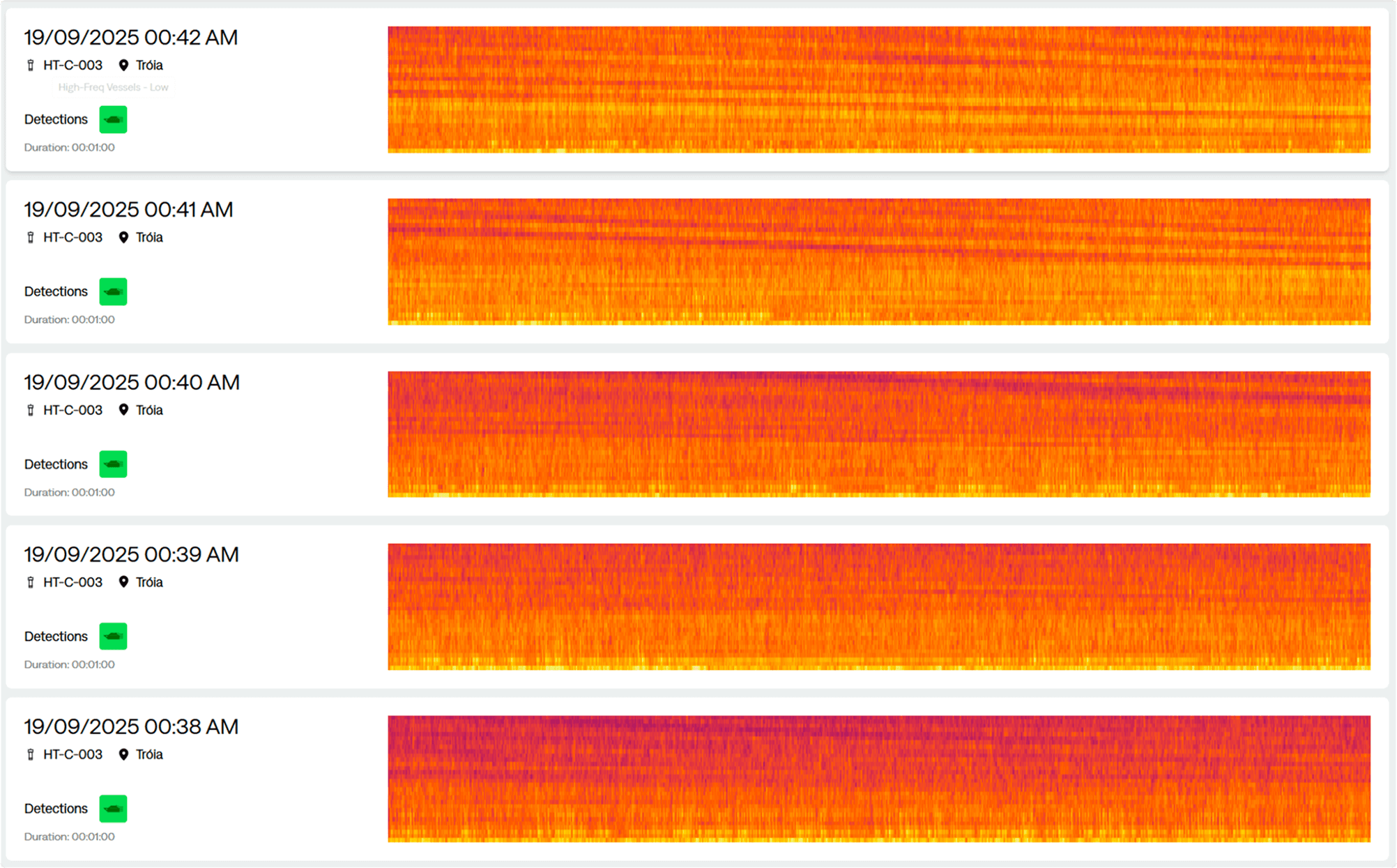
Spectrograms from five consecutive HT-C recordings between 00:38 and 00:42 UTC on September 19, showing clear acoustic vessel signatures with no corresponding AIS targets.
These are not false positives. They are real vessel detections — of vessels that were simply not transmitting AIS. Whether due to equipment failure, deliberate deactivation, or the absence of an AIS requirement for that vessel class, these passages would have been entirely invisible to any AIS-dependent monitoring system.
Hydrotwin detected them. Users are automatically notified in the Hydrotwin web application and can review the associated spectrograms and audio evidence directly in the dashboard, enabling rapid assessment and escalation where required.
This finding reframes how we should interpret Hydrotwin's precision metric in coastal continuous operation. The true precision of the system is higher than the AIS-matched figure suggests — because some of what AIS calls a false positive is, acoustically, a true detection.
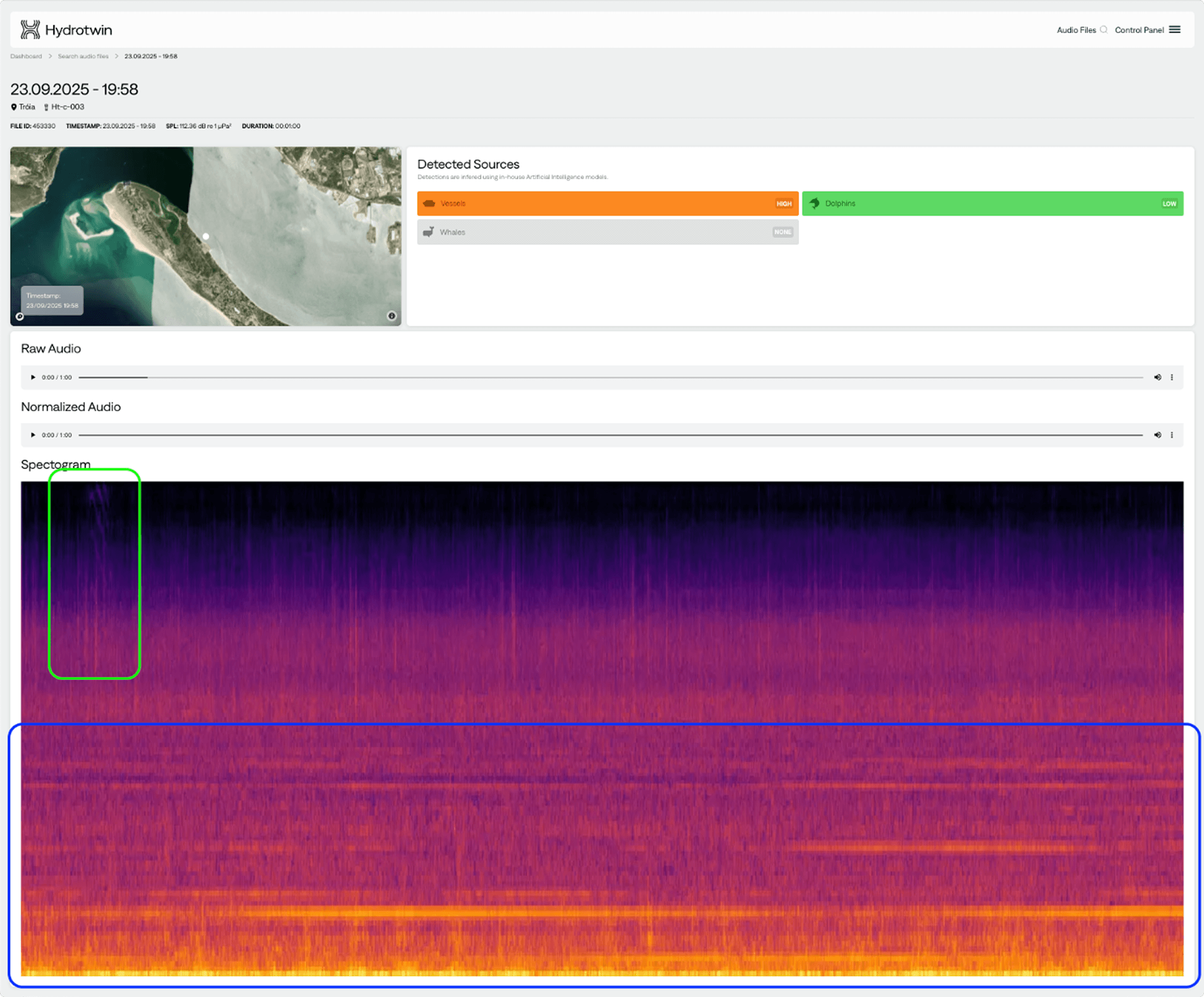
Vessel and dolphin detections by HT-C during REPMUS 2025, as displayed in the Hydrotwin dashboard. The blue box marks the vessel acoustic signature; the green box marks the dolphin whistle.
Dolphin detection: precision-first by design
Dolphin detection was evaluated against a 10-hour subset of HT-C-003 recordings — the period with the highest concentration of AI detections — manually annotated by our in-house acoustic experts. Across that window, 282 dolphin whistles were identified across 74 one-minute recordings.
Hydrotwin flagged dolphin presence in 35 files, of which 29 were confirmed true positives. This corresponds to a precision of 81.8% and a recall of 47.3%. The relatively conservative recall is intentional. For long-term passive acoustic monitoring — where recordings may span months and post-processing effort is a real operational constraint — a high false positive rate is more damaging than a missed detection. When Hydrotwin reports a dolphin, operators can trust that report.
The detection threshold can be adjusted to favour higher recall at the cost of more false positives — a configuration appropriate for survey scenarios where completeness matters more than precision. The REPMUS results establish a clear baseline from which that trade-off can be deliberately tuned.

What comes next
REPMUS 2025 established concrete performance baselines across two hardware configurations, two detection domains, and a range of real-world environmental conditions. The results validate Hydrotwin's dual-use applicability: as an environmental monitoring tool for cetacean research and biodiversity protection, and as a maritime security asset capable of detecting vessel traffic that conventional systems miss.
Ongoing development is focused on expanding training datasets to improve recall, advancing from presence-detection to species-level and vessel-class-level classification, refining detection thresholds for different operational contexts, and implementing advanced acoustic feature extraction techniques to increase detection granularity. All configurations run continuously improving AI models as new field data is acquired and labelled.
Continued multi-site, multi-season validation campaigns will further refine model robustness and support broader operational deployment.
The full methodology, performance analysis, and acoustic propagation modelling results are available in the peer-reviewed publication: Vanneste et al., "Field Validation of Hydrotwin for Automated Vessel and Dolphin Detection,", 2025.
Related
Related Publications